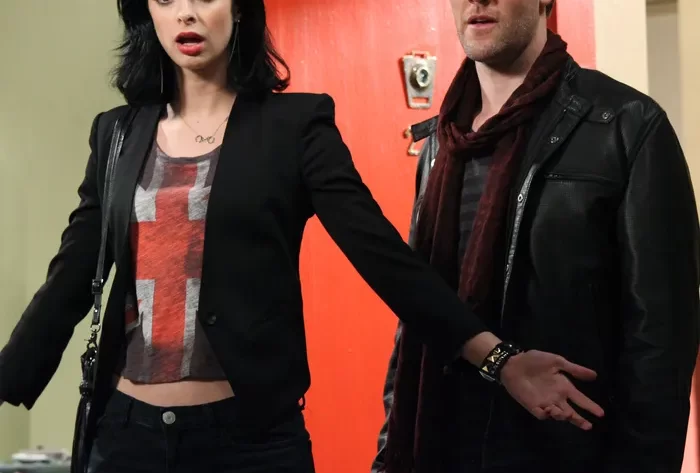
I’m sure I’m not the only one who gets excited when the stars of teen shows past resurface in pop culture. Currently gracing your TV, you can find My So-Called Life‘s Angela fighting terrorists on Homeland, Friday Night Lights‘ Luke home from Afghanistan on Parenthood, Buffy‘s Willow married to Freaks and Geeks‘ Nick on How I Met Your Mother, and Dawson’s Creek‘s title character playing… well, the actor who played Dawson on Don’t Trust the B—- in Apartment 23.
Beyond casting a teen drama alum, on Apt. 23, James Van Der Beek’s history as Dawson Leery is front and centre. His role as one of the four main characters translates into continual references to the (now 15 year old) teen drama. Simultaneously mocking/parodying himself and the celebrity culture that sustains the egos of once popular actors, the character of “James” also keeps the memory of teen drama love alive for the sitcom’s young adult audience.
Series protagonist, June, meanwhile, a 20-something searching for satisfying work in business in a failing economy while working the counter at a local coffee shop, stands in for all those 20- and 30-somethings for whom Dawson’s Creek was teen drama sustenance. June reminds us every few weeks how back in her mid-west hometown, she and her friends were obsessed with the series. A decade later and she still knows plots and episodes by heart. As with Jame’s celebrity self-parody, June demonstrates how ridiculous it can be to fall under the thrall of a teen soap, all the while pandering to a self-deprecating audience of young people who identify with her fandom.
In these ways, Apt. 23, in all it’s goofy cartoonesque farce, is superbly pitched to a generation of young adults who found solace in the teen television of their time. While they’ve certainly grown into adulthood, for many people like June, adulthood does not bring self-knowledge or satisfaction, and does not necessarily signify maturity. For those stuck in a pre-career, pre-marriage and family, pre-actualization limbo, Apt. 23 hearkens back to the comforting side of the tumultuous teen years; a time when we could love a TV show more than ourselves.
The brilliance in this appeal is that the series seems painfully aware that the nostalgia it relies on is hokey and ridiculous. Thinking of our teen years as comforting, for most people, is just a self-deluding lie. And yet finding comfort in melodramatic teen stories we once loved, with the awareness of how silly they were, is a large part of what Don’t Trust the B—- in Apartment 23 is all about, and what makes it so fun to watch.