
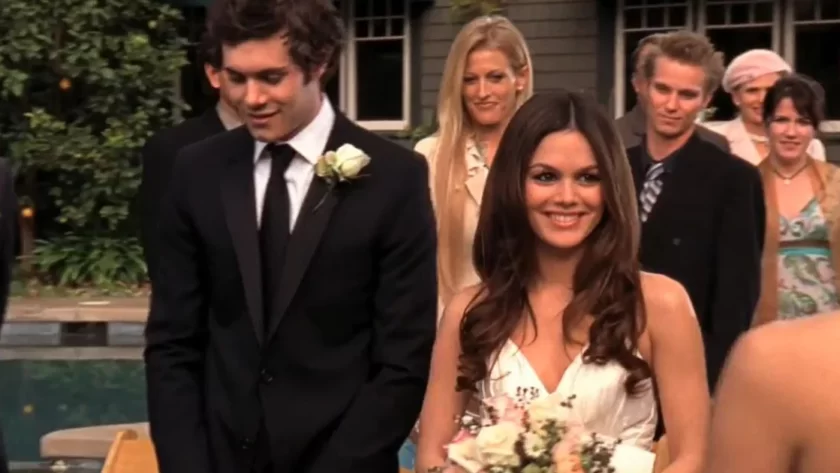
Teen television is often contradictory in its message. In particular, when romance is involved, shows about young people tend to endorse the idealized “happily ever after” trope, traditionally celebrated in marriage. This fuels the romantic ideal that a couple can stay together forever, that the “love of my life” spouse can be someone met in high school.
Yet despite this romantic idealism, teen TV simultaneously stands firmly with the pragmatic notions that teens are too young to commit themselves for life, they shouldn’t throw their lives away by choosing a partner so soon, why not wait until you’re older? After all, you haven’t even experienced anything else yet, play the field a little! A logic that is above all resistant to teen marriage.
Although there have been a fair number of young people getting married shortly after graduating high school, often as part of the romantic happily ever after trend, there is a clear absence of teen weddings on teen shows. It is an absence most people wouldn’t notice, since no one expects people under the age of majority to get married, and yet it is an absence that is underlined and emphasized by how close some young couples get to the altar before backing down and changing their minds.
Two of these near-teen-weddings follow the same pattern. On Skins, Grace and Rich run away with their friends to get married, despite Grace’s father’s disapproval – not only of his daughter’s teen wedding, but of her boyfriend more generally – but ultimately choose not to get hitched, realizing they can love each other as unwed boyfriend and girlfriend. Although Grace’s parents track them down to stop them at the last second, it is the teen couple who change their mind, realizing that marriage isn’t a necessary step to take.
Similarly, on Degrassi, Drew and Bianca fly to Las Vegas with a few friends planning to get married after Drew’s mom vehemently opposed their wedding plans because she just couldn’t support a teen marriage no matter how independent and responsible her son may be, or how much he may love Bianca. Regretting eloping without his mother being there to witness this major life event, Drew has a change of heart. While his mother shows up at the last minute to stop the wedding, Drew himself convinces Bianca that the couple should wait until they can have a proper marriage ceremony with their families around them at some unspecified time in the future.
Confusingly, marriage continues to be held up as the ideal ending for a teen love story, despite parents’ vehement disapproval, and teens’ ultimate cold feet. While the arguments made against teen marriage tend to rely on inexperience, and a need to “play the field” and get to know more about “life” before “settling down” the teen couples who back down from getting married very young do no such thing. Both of the above couples continue dating, imagining that they will get married, eventually. It is simply a matter of letting the wedding come in its time, when the adolescent story has run its course, and adult life begins.
For instance, Seth and Summer on the O.C. demonstrate how a young couple planning a wedding too young simply need to wait. At 18, neither of them actually wants to go through with their wedding, having fallen into an engagement at the thought of a pregnancy scare. Pulling the plug at the last minute, the wedding does not happen, but the couple stays together, waits it out, and finally gets married later, when it’s appropriate, at the very end. By the finale, they have begun their lives and are ready to have a grown up relationship together, living happily ever after.
And yet, contradictions amass. Marriage continues to be idealized as the ultimate end point for the fated teen romance, while at the same time, series depict the sometimes troubling reality of life after the wedding. Dean and Lindsay separate after he cheats on her, on Gilmore Girls. Isabelle nearly loses Jesse after he finds out he had unwittingly married an alien on Roswell. Andrea ends up pregnant and married, instead of the Ivy League scholar she’d always dreamed of becoming, on BH 90210.
Of course this leaves the genre’s message about romance a little unclear. Commitment and marriage are idealized, and no less so if sweethearts meet in high school. Yet we are to be wary of early commitment. For whatever reason, couples are not expected to stay together from early on, and young newlyweds, although facing little objection, often deal with the fallout of problematic marriage complications.

Perhaps unsurprisingly, then, every couple who ends up together is one of those on again off again couples who dated, but also tried not dating, realizing finally (by being apart perhaps) that they are meant to be together. From Roswell‘s Max and Liz, to Friday Night Lights‘ Julie and Matt, teenage lovers who are meant to be together seem to end up so. It is a muddy mix of fate, experience, true love, and appropriate timelines, but perhaps most significantly, happily ever afters provide the ultimate satisfaction for viewers to see their favourite couples end up together forever.
While some lesser characters may experience the pain of failed marriage, through the magic of television writing, some of our favourite couples, the ones we can’t help rooting for, are pretty much guaranteed to make it to the romantic finish line, by tying the knot at the moment the series ends. Without the need of drama to carry television narratives forward, we are left with those cheerful shots of early wedded bliss, and are free and encouraged to happily imagine the perfect lives that are about to unfold.


